

Refinery Catalyst Market Set to Surge: Key Trends, Growth Drivers, and Top Players 2025-2032 | DataM Intelligence
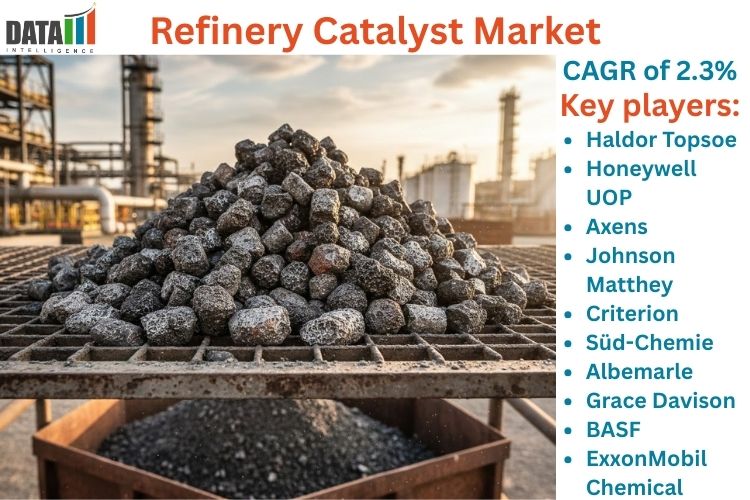
Refinery Catalyst Market
The Global Refinery Catalyst Market is estimated to grow at a CAGR of 2.3% during the forecast period 2024-2031.
The Refinery Catalyst Market is witnessing robust growth, driven by rising petroleum demand, technological advancements, and increasing refinery capacities globally.”
AUSTIN, TX, UNITED STATES, January 14, 2026 /EINPresswire.com/ -- Market Overview: — DataM Intelligence
The Refinery Catalyst Market plays a critical role in the global petroleum refining industry, enabling the conversion of crude oil into high-value products such as gasoline, diesel, jet fuel, and petrochemical feedstocks. Catalysts are essential for key refining processes including fluid catalytic cracking (FCC), hydrocracking, hydrotreating, alkylation, and reforming, where they enhance reaction rates, improve selectivity, and reduce energy consumption. As refiners seek to process heavier and more complex crude slates while meeting stringent fuel quality and environmental regulations, the demand for advanced and high-performance catalysts continues to rise.
To Download Sample Report Here: https://www.datamintelligence.com/download-sample/refinery-catalyst-market
The growth is primarily driven by rising global energy demand, increasing complexity of crude oil feedstocks, and stricter sulfur and emission regulations that necessitate higher catalyst efficiency. The fluid catalytic cracking (FCC) catalyst segment currently holds the largest market share due to its extensive use in converting heavy fractions into lighter transportation fuels. Geographically, Asia-Pacific dominates the market, led by China and India, owing to rapid capacity additions, expanding petrochemical integration, and growing fuel consumption across transportation and industrial sectors.
Key Highlights from the Report:
The Market is witnessing steady growth due to rising demand for clean fuels and stricter environmental norms.
FCC catalysts account for the largest revenue share, driven by high gasoline and olefin production.
Asia-Pacific leads the global market with continuous refinery expansions and upgrades.
Hydrotreating catalysts are gaining traction due to ultra-low sulfur fuel regulations.
Technological advancements are enabling longer catalyst life and higher activity levels.
Integration of refining and petrochemical complexes is boosting demand for specialty catalysts.
Market Segmentation Analysis:
The Refinery Catalyst Market is segmented based on product type, application, and end-user processes, each reflecting the diverse operational needs of modern refineries. By product type, the market includes FCC catalysts, hydro processing catalysts, reforming catalysts, and others such as alkylation and isomerization catalysts. FCC catalysts form the backbone of many refineries, as they are crucial for breaking down heavy hydrocarbons into lighter fractions like gasoline and propylene. Hydro processing catalysts, including hydrotreating and hydrocracking variants, are increasingly important for sulfur removal and for upgrading heavier feedstocks into cleaner fuels.
In terms of application, catalysts are deployed across processes such as catalytic cracking, hydrotreating, reforming, and alkylation. Hydrotreating catalysts are experiencing robust demand due to global mandates on low-sulfur and ultra-low-sulfur fuels, especially in diesel and marine fuels. Reforming catalysts, on the other hand, support the production of high-octane gasoline and aromatics, which are essential for both transportation fuels and downstream petrochemical production.
From an end-user perspective, the market is segmented into oil refineries, integrated refining-petrochemical complexes, and specialty chemical producers. Integrated complexes are becoming increasingly prominent, particularly in Asia and the Middle East, as they allow refiners to maximize value by converting crude oil directly into both fuels and petrochemical intermediates. This integration is driving the adoption of advanced, tailor-made catalyst formulations designed for multi-process optimization and higher throughput.
Speak to Our Analyst and Get Customization in the report as per your requirements: https://www.datamintelligence.com/customize/refinery-catalyst-market
Regional Insights:
Asia-Pacific represents the largest and fastest-growing regional market for refinery catalysts. Rapid industrialization, urbanization, and vehicle ownership growth in countries such as China, India, and Southeast Asian nations are driving strong demand for transportation fuels and petrochemical products. Large-scale refinery expansions, capacity additions, and upgrades to meet stricter fuel quality standards are fueling the adoption of high-performance catalysts across the region.
North America holds a significant share of the market, supported by the presence of technologically advanced refineries and a strong focus on processing unconventional feedstocks such as shale oil. The region is also at the forefront of catalyst innovation, with refiners investing in solutions that improve yield, energy efficiency, and operational flexibility. Europe follows closely, driven by stringent environmental regulations and the transition toward cleaner fuels, which has increased the use of hydrotreating and desulfurization catalysts.
The Middle East and Africa are emerging as important growth regions due to large investments in new refining and petrochemical complexes. Countries in the Gulf Cooperation Council (GCC) are focusing on downstream diversification, which is creating sustained demand for advanced refinery catalysts. Latin America, while smaller in market size, is witnessing gradual growth supported by refinery modernization projects and rising domestic fuel consumption.
Market Dynamics:
Market Drivers
One of the primary drivers of the refinery catalyst market is the rising global demand for clean and high-quality fuels. Stringent regulations on sulfur content and emissions, such as Euro VI and equivalent standards worldwide, are compelling refiners to invest in advanced hydrotreating and hydrocracking catalysts. Additionally, the increasing processing of heavier and sour crude oils requires more robust and efficient catalyst systems capable of maintaining performance under severe operating conditions.
Market Restraints
High costs associated with advanced catalyst development and frequent replacement cycles pose a challenge for market growth. Catalyst deactivation due to poisoning, fouling, and thermal degradation can lead to operational downtime and increased maintenance expenses. Moreover, volatility in crude oil prices can impact refinery utilization rates and capital expenditure, indirectly affecting catalyst demand.
Market Opportunities
The growing integration of refining and petrochemical operations presents significant opportunities for catalyst manufacturers. Demand for multifunctional catalysts that can optimize both fuel and chemical production is rising, particularly in Asia and the Middle East. Furthermore, advancements in nanotechnology, materials science, and digital process optimization are opening new avenues for the development of next-generation catalysts with longer lifespans, higher selectivity, and improved environmental performance.
Looking For Full Report? Get it Here: https://www.datamintelligence.com/buy-now-page?report=refinery-catalyst-market
Frequently Asked Questions (FAQs):
How Big is the Global Refinery Catalyst Market in 2024?
Who are the Key Players in the Global Refinery Catalyst Market?
What is the Projected Growth Rate of the Refinery Catalyst Market during the Forecast Period?
What is the Market Forecast for the Refinery Catalyst Industry in 2032?
Which Region is Estimated to Dominate the Refinery Catalyst Market through the Forecast Period?
Company Insights:
Key players operating in the Refinery Catalyst Market include:
Haldor Topsoe
Honeywell UOP
Axens
Johnson Matthey
Criterion
Süd-Chemie
Albemarle
Grace Davison
BASF
ExxonMobil Chemical
Recent Developments:
United States:
December 2025: Refinery catalyst revamps emphasized emission-compliant hydroprocessing systems, driven by federal policies targeting net-zero goals, with pilot tests showing 15% better light ends conversion. Shale-driven feedstock shifts necessitated these multifunctional catalysts.
November 2025: Hydrotreating catalysts saw increased adoption following Department of Energy incentives for cleaner diesel production, with new formulations improving sulfur removal efficiency by over 20% in high-pressure units. This responded to domestic fuel quality mandates and export demands. Major players accelerated R&D for naphtha reforming compatibility.
October 2025: U.S. refiners advanced fluid catalytic cracking (FCC) catalysts to boost gasoline yields amid rising shale oil processing, aligning with EPA Tier 3 standards for ultra-low sulfur fuels. Innovations focused on zeolite enhancements for better thermal stability and emissions reduction in complex refinery setups. These upgrades supported higher throughput in Gulf Coast facilities.
Japan:
December 2025: Collaborations with research institutes advanced multifunctional catalysts for desulfurization, focusing on biobased options to cut carbon in refining amid renewable energy shifts. Digital AI integration optimized catalyst performance.
November 2025: Hydrocracking catalysts gained traction for clean diesel and jet fuel production, supporting Japan's biofuel transition and high-severity operations above 750°C. Demand rose with policy pushes for fuel efficiency.
October 2025: Fuji refinery upgrades introduced dual-function catalysts merging cracking and hydrocracking, enhancing energy efficiency and reducing process steps for complex feeds. This innovation met stringent local emissions rules while optimizing yields.
Unlock 360° Market Intelligence with DataM Subscription Services: https://www.datamintelligence.com/reports-subscription
Conclusion:
The Refinery Catalyst Market is a vital component of the global energy and petrochemical value chain, underpinning the efficient and sustainable conversion of crude oil into essential fuels and chemicals. Driven by rising energy demand, tightening environmental regulations, and increasing crude oil complexity, the market is poised for steady growth through 2032. With FCC and hydroprocessing catalysts leading in terms of adoption, and Asia-Pacific emerging as the dominant regional hub, opportunities abound for innovation and expansion. As refiners continue to modernize and integrate operations, advanced catalyst technologies will remain central to enhancing productivity, compliance, and profitability across the global refining industry.
Related Reports:
Polypropylene Catalyst Market
Phase Transfer Catalyst Market
Sai Kiran
DataM Intelligence 4Market Research
+1 877-441-4866
Sai.k@datamintelligence.com
Visit us on social media:
LinkedIn
X
Legal Disclaimer:
EIN Presswire provides this news content "as is" without warranty of any kind. We do not accept any responsibility or liability for the accuracy, content, images, videos, licenses, completeness, legality, or reliability of the information contained in this article. If you have any complaints or copyright issues related to this article, kindly contact the author above.
