

AI Cheating Accusations Surge, Leaving Students to Face High-Stakes Misconduct Proceedings
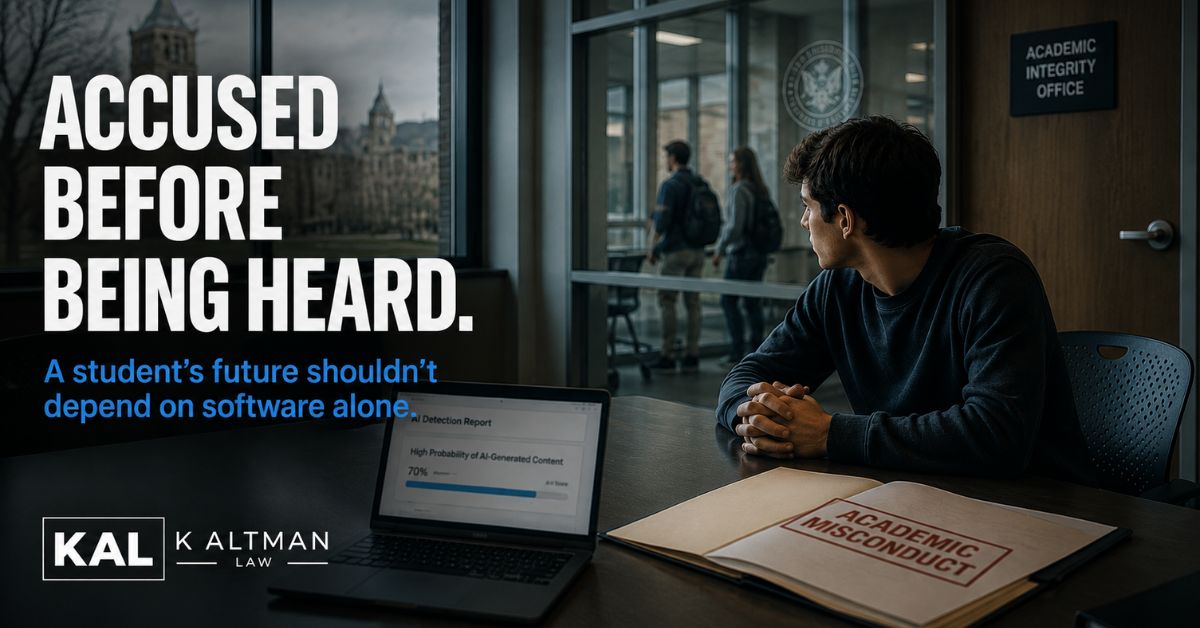
A single AI flag can trigger a process that shapes a student's academic future long before the evidence is fully understood.

Keith Altman Founder of K Altman Law
AI misconduct accusations are rising nationwide, leaving many students to defend their academic future against uncertain evidence and inconsistent policies.
The CBS News segment features an attorney discussing failed assignments flagged as AI-generated and what the outlet describes as 'the evolving industry of academic AI-defense lawyers.' You can read about it here.
The Problem: Flawed Detection, Inconsistent Policy, Serious Consequences
AI content detection software has become a standard feature of academic integrity platforms used by universities nationwide. Yet the publishers of these tools, including industry leaders, have publicly acknowledged that their products identify suspected AI content as a data point, not a definitive finding of misconduct. False positives have been reported across a wide range of student submissions, including work completed entirely without AI assistance.
At the same time, institutional policies governing AI use in coursework remain inconsistent. Some universities maintain detailed guidance distinguishing permissible AI tools from prohibited ones. Others rely on existing plagiarism or academic honesty policies that predate the emergence of generative AI. In either environment, students who receive misconduct notices may be left without clear notice of the specific rules they are alleged to have violated, the evidence being used against them, or their rights during the review process.
The consequences of an adverse academic integrity finding can be severe: a failing grade on an assignment or in a course, placement on academic probation, notation on a disciplinary record, loss of scholarships or financial aid eligibility, suspension, or expulsion. These outcomes can follow a student for years and affect graduate school admissions and professional licensing.
The Legal Landscape: Due Process and Student Rights
Students accused of academic misconduct at colleges and universities retain important rights throughout the disciplinary process, though the scope of those protections depends on whether the institution is public or private and on the specific policies in place. At public institutions, constitutional due process considerations generally apply, requiring adequate notice and a meaningful opportunity to respond. At private institutions, students are typically entitled to the procedural protections set forth in the school's own academic integrity policies and student handbook.
Students with documented disabilities may have additional rights under the Individuals with Disabilities Education Act (IDEA), Section 504 of the Rehabilitation Act, and the Americans with Disabilities Act. In some cases, AI detection flags may intersect with writing style variations attributable to a student's disability—adding a civil rights dimension to what might otherwise appear to be a straightforward academic integrity matter.
"Every student accused of AI-related academic misconduct deserves a fair process anchored in real evidence, not an algorithm's flag," said Keith Altman, Founder and Managing Partner of K Altman Law. "These cases raise serious questions about notice, reliability of evidence, and procedural fairness. Families should understand that a misconduct accusation is not a final determination, and that students have the right to respond and to seek guidance."
What Families and Students Should Do Now
If a student receives notice of an AI-related academic integrity investigation or charge, the following general steps may help protect their interests:
• Obtain and carefully review the institution's academic integrity policy, including any provisions specifically addressing AI-generated content.
• Request a copy of all evidence being used against the student, including any AI detection reports and the specific passages or portions flagged.
• Preserve documentation of the student's own writing process, including drafts, notes, outlines, and any correspondence with instructors about the assignment.
• Avoid making informal statements about the assignment or the accusation before understanding what the disciplinary process requires.
• Consult with an education attorney to understand the student's procedural rights and available response options before any formal meeting or hearing.
Students should be aware that appeal rights may be time-sensitive, and that early engagement with the process is often critical to preserving options.
About K Altman Law
K Altman Law is a national education law firm dedicated to protecting the rights of students and families across the country. The firm's practice areas include student discipline defense, special education law (IDEA/IEP/504), Title IX and civil rights, and college athletics and NIL compliance. K Altman Law serves clients in Michigan, California, Texas, New York, New Jersey, Pennsylvania, Illinois, Tennessee, Florida, and across the United States.
Website: www.kaltmanlaw.com
DISCLAIMER: This press release is for general informational purposes only and does not constitute legal advice.
Keith Altman
K Altman Law
+1 888-984-1341
kalonline@kaltmanlaw.com
Visit us on social media:
LinkedIn
Instagram
Facebook
YouTube
TikTok
X
Legal Disclaimer:
EIN Presswire provides this news content "as is" without warranty of any kind. We do not accept any responsibility or liability for the accuracy, content, images, videos, licenses, completeness, legality, or reliability of the information contained in this article. If you have any complaints or copyright issues related to this article, kindly contact the author above.
