

Yes, AI can write your pitch. But can it give journalists what they need?

Artificial intelligence isn’t just being used to write press releases. It has found its way into media pitching. Yet, according to a new report on media pitches from Help a Reporter Out (HARO), most pitches still have a human behind them.
Of the more than 2 million media pitches analyzed by HARO, 79 percent had some human involvement, HARO CEO Brett Farmiloe said in an interview with EIN Presswire. The other 21 percent were entirely AI‑generated.
The analysis from HARO – a service connecting journalists who need sources with people who can offer expert commentary and quotes – pointed to another finding that may give those pitching to reporters reason to rethink the instant written pitch AI can spit out in a matter of seconds.
That’s because human-written pitches were about three times more likely to get featured than AI-written ones, according to the HARO report. In other words, journalists were more likely to use a pitch written by a person than one generated entirely by an AI tool.
“That comes from our own analysis of pitches and placements across our platforms,” Farmiloe said, adding that journalists have the “best AI detection system far better than any technology.”
“Why? Because they’ve seen it all in their inbox,” he said. “Most journalists I speak with say that they can tell when a pitch is AI generated or not, just from a ‘blink’ test (where in 1 second or less, they can just tell).”
The report on pitches paints a picture of a PR industry embracing AI in its processes while still finding value in maintaining a human element, especially in media pitching. Relying entirely on AI could come at a cost, since human-written pitches had a higher success rate, according to the HARO report.
Another key finding Farmiloe pointed out is that “35 percent of journalists switched on the filter that blocks AI-generated pitches.” The box is unchecked by default, he added.
Meanwhile, journalists use the HARO platform to find sources for upcoming stories, and sources respond to media requests for a chance to be included in news coverage. The report covers HARO’s first year after its 2025 relaunch, with the findings released in August 2026. Every pitch was analyzed using AI detection technology.
Farmiloe said he has seen more than 3 million media pitches across these platforms, giving him a firsthand look at trends in today’s media and how they are impacting the PR world.
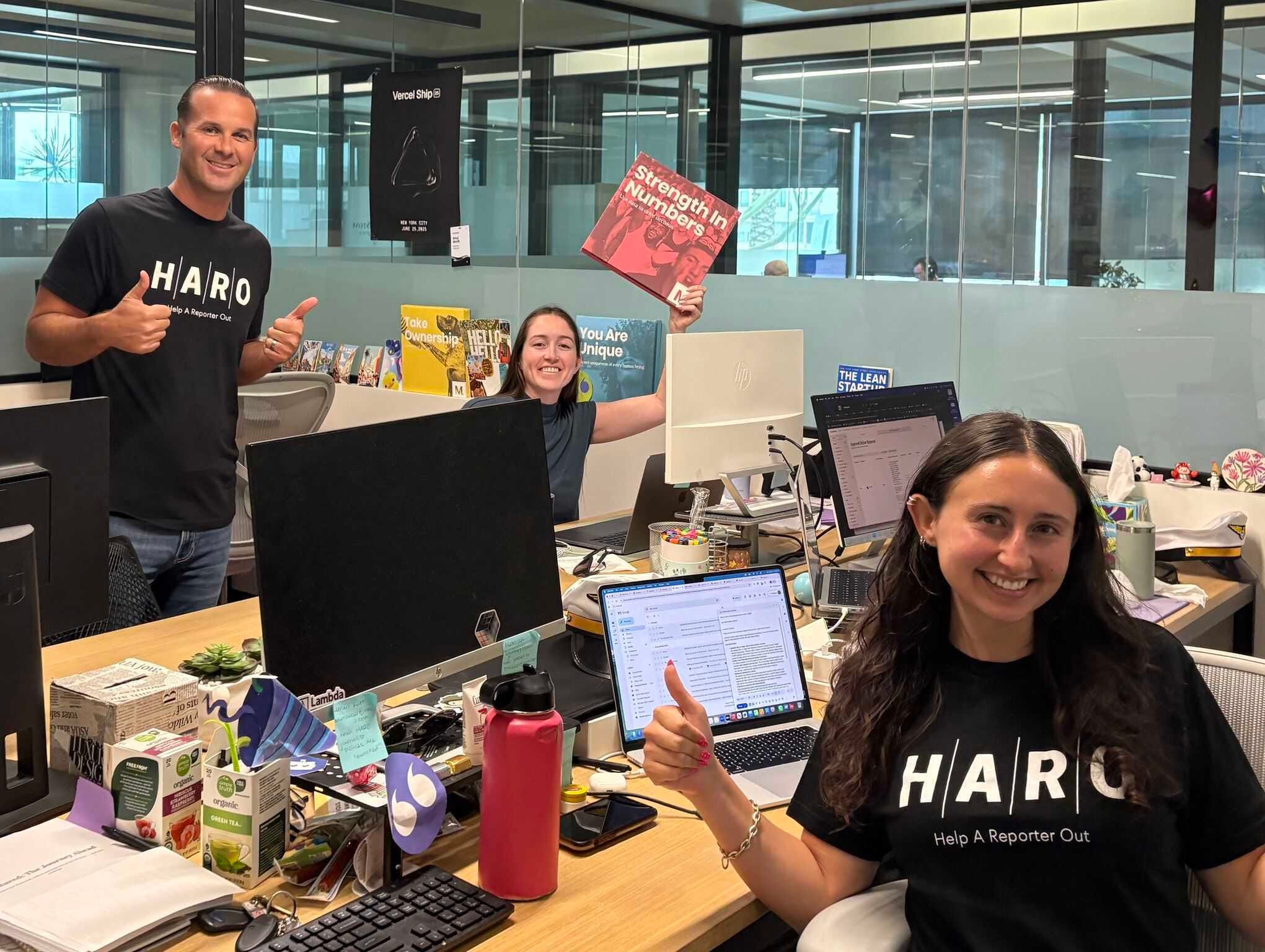
He acquired HARO from Cision on April 15, 2025, and “the first email edition went back out on April 22, one week later,” Farmiloe said.
In a separate report from HARO’s sister brand Featured, data showed that AI platforms are also turning to media coverage when deciding what information to include in AI-powered responses.
Roughly two-thirds of classified citations came from editorial sources, while brand-owned content accounted for less than 2 percent. Featured is an AI-powered public relations platform that matches founders and experts with journalist requests to secure earned media coverage.
The findings suggest that companies can publish information on their own websites but may have a tough time getting that information cited by AI platforms.
Coverage from independent editorial sources appeared far more often in the citations analyzed by Featured.
Farmiloe sat down with EIN Presswire, a press release distribution company, to discuss how AI is changing the media pitching game, why human expertise still matters and what communicators can do to stand out as AI-generated content becomes more common.
Editor’s note: This interview has been slightly edited for length, clarity and brevity.
Q: When it comes to media pitching, talk to us about how it has changed with the emergence of AI. How many people are using AI to pitch?
A: We run every HARO and Connectively pitch through AI detection. Across more than 2 million pitches about 21 percent came back as 100% AI-generated. That’s roughly 420,000 pitches with no humans in them.
That said, there’s good and bad when it comes to using AI to pitch. The bad is not including any human oversight in the pitch process, and having everything entirely machine-written. No matter how sophisticated the set up, that’s just spam.
We see many users incorporate AI into their workflow process in ways I think are healthy. For example, using AI to research a journalist and learn about their pitch preferences.
We also see mixed AI usage, where a source might voice their original thoughts into their AI while working out on a treadmill, and then use AI to formulate a pitch from those original thoughts. That mixed use case doesn’t show up in the 21 percent.
The other trend is the ratio. Pitching costs less, which has resulted in more volume. On Connectively we see an average of 42 responses for every journalist request.
Pitching isn’t a numbers game. It’s about quality. Less is more in 2026. The people winning on our platforms are sending fewer pitches at higher quality, and they’re using AI to get smarter about who they pitch, not to write the pitch for them.
Q: In your report we see that human pitches are favored by journalists over AI pitches. Expound more on the success rate between human media pitches and AI-generated ones?
A: We see 35 percent of journalists opt out entirely of receiving pitches we flag as AI-generated. Those journalists just want to spare their inbox.
The other 65 percent of journalists who receive all pitches see an AI-detection score next to the pitch. If you’re a journalist, and you see a red, 100% AI-generated label next to a pitch, then you’ll likely pause and analyze that pitch more critically than a green, 100% human-written label.
That said, journalists tend to split into two camps on AI usage. One camp is adamantly opposed and filters. The other camp only cares about getting connected with the right source, because they’re going to pick up the phone anyway and get what they need in their own words. The interesting part is that both camps reward the same thing: a specific, credentialed human who answered the actual question.
For context on the base rate, a typical query draws about 42 pitches. A journalist might use one quote. A publisher might use ten. So the math was never friendly to volume. AI made it worse for the people who used it as a shortcut, and better for the people who used it to get more relevant.
Q: What advice would you give publicists these days who are pitching to the media?
A: HARO stands for Help a Reporter Out, but the acronym also serves as a helpful guide for publicists looking for a checklist to improve their pitches. Be Helpful, be Authentic, be Relevant, be On time.
Helpful means you help the journalist do their job. If your pitch helps them do their job, send it. If it doesn’t, don’t.
Authentic means you’re not AI. You’re human. You can use AI to research and to get a draft going, but the thing you send has to be above what ChatGPT would produce on its own. AI raised the quality bar. A generic answer is now free, so it’s worth nothing.
Relevant means credentials. If the reporter needs a left-handed pulmonologist in Michigan, your marketing director is not relevant, no matter how good the writing is.
“On time” is misunderstood. It’s not about being first in line. It’s about being at the top of the line, with the best credentials and the most useful answer, inside the window the journalist is working in. If you follow the HARO acronym for pitching, you’ll find success on HARO.
Q: What’s the recipe for the most engaging story in today’s instant and fast world? What captivates readers the most right now?
A: I think expert reaction stories to today’s news are the most interesting and compelling pieces that are appearing in publications.
LinkedIn News is a great example. People are living on LinkedIn these days, and their content with top perspectives from experts seems to be a big success for them. They’ve got 250 editors on staff producing that content, and it all goes back to elevating expert opinion.
Readers are captivated by what’s new, and what it means for them. AI set a new quality threshold, which assigned a premium to human perspective. I think that’s why HARO’s revival is timely. Everyone is an expert in something, and journalists need a fast and reliable way to feature that expertise.
Q: When everyone can use AI to sound authoritative, how has the definition of an “expert source” changed?
A: The title and credentials matter. AI can polish any pitch into an authoritative stance. Now, it matters more about who is sharing that stance. Google gave this a framework almost a decade ago: E-E-A-T. Experience, Expertise, Authority, and Trust.
We’re in an era where the currency of a source feels attached to E-E-A-T. Do they have the experience that positions them as an expert? Can they be trusted?
AI is making it harder to answer those questions. We’ve had to work hard to produce verification signals around the experts on our platforms, so that journalists can confidently feature sources in stories.
Before a profile on our platforms gets in front of a journalist it goes through seven or eight checks, everything from email verification to matching the details in the profile against third-party data and a LinkedIn profile. Then the submission itself gets an AI score.
An expert source is someone who can pass the credibility checks, and provide, authentic answer that goes above what the model would have said. The bar for getting featured went up, and I think that’s a net positive for journalism.
Q: You mentioned an AI citation study involving, I believe, at least 22,000 media pitches. Tell us more about that.
A: To clarify, we looked at 22,881 AI citations. In August we published the Featured AI Citation Report. We ran 405 AI visibility audits for 378 brands, asked the AI platforms 1,983 buying questions, the kind a customer would actually type, and then traced 22,881 citations back to 11,499 domains to see where the answers were coming from.
Roughly two-thirds of the citations we could classify came from editorial sources. Brand-owned content was 1.7 percent. The owned media pages a company controls don’t often get cited by AI, while earned media pages often appear in AI answers. That’s why we’re seeing growth and interest in our journalist request platforms. People want to find a way into AI answers.
I think one of the more interesting findings is that the sources being cited are generally niche sites. The median cited domain had a domain authority of 37. The distribution has two humps: 31.2 percent of citations went to sites with a DA of 80 or higher, and 34.5 percent went to sites under 40. A mom-and-pop blog that happens to be well structured can outrank a major outlet inside an AI answer.
Media mentions help with model mentions. That’s the short version. The full report is here.
Q: Are there any safeguards you’ve implemented for HARO?
A: A lot, and most of them are invisible to a well-behaved user. HARO is still just an email.
Behind the email, every pitch runs through AI detection. We partner with Pangram for that, and we think it’s the strongest detector on the market. We also run automation checks for people who have fully automated their submissions to get around the detector.
Every journalist request is reviewed and approved by a person before it goes out. We verify that the journalist writes for the publication, and for websites we require a minimum Moz domain authority of 20. Podcasts are exempt. About 32 percent of requests get rejected at that step.
Profiles are verified on the source side with the seven or eight checks I mentioned. And journalists can report any pitch as not helpful, which goes straight to our team.
Then there are bans. We ban a HARO account every 23 minutes, mostly for spam and terms-of-service violations. HARO is supported by newsletter ads, not subscriptions, so there’s no revenue reason to slap someone on the wrist. Bad acting is a one-click permanent ban, and we have a lot of apology emails in our inbox.
The one thing that will never get you banned on its own is an AI score. It would be irresponsible for us to say “100% AI, you’re out.” There are false positives. It’s one signal of many, and a person on our team makes the call.
Legal Disclaimer:
EIN Presswire provides this news content "as is" without warranty of any kind. We do not accept any responsibility or liability for the accuracy, content, images, videos, licenses, completeness, legality, or reliability of the information contained in this article. If you have any complaints or copyright issues related to this article, kindly contact the author above.
